Tuesday, September 7, 2010

Your Pencils May Be Worth More Than You Thought


Since you guys are spending so much time with your pencils lately, I thought this article might appeal to you.

Thursday, September 2, 2010

Homework Due September 7

Interior: One-Point Perspective
Choose an interior space from which to draw. Make sure that you are comfortable in this space because you will be using it for the next two homework assignments as well.

Working from observation, but using the interior mostly as a guide, draw the interior in one-point perspective. Remember with each object you draw to begin with a flat, geometric shape with no foreshortening and THEN recede your orthogonals (please forgive my mispronunciation of that word in class) to the vanishing point. For this assignment, I don't need to see your orthogonals receding all the way to the vanishing point like we did in class. You can erase any lines that do not define the object you are drawing.

Here's a good online tutorial to practice drawing interiors in one-point perspective: http://www.olejarz.com/arted/perspective/start.html (Just ignore the suggestion to not use soft pencils. That's what we're using here, folks!)

LINE ONLY

Materials: Drawing pencils (2B, 4B, 6B), yardstick, bond paper (18"x24")

Blog: Search the Internet for artists' images demonstrating 1-, 2-, and 3-point perspective. Post good examples to your blog and label them.

If you don't know how to download an image, here are some steps: (I'm assuming everyone is a Mac user) Place the pointer on the image you want to download and right-click (or press "control" on the keyboard and click if the right-click doesn't work). Scroll down to "Save Image to Downloads" and click. The image is now in your "downloads" folder.

Click HERE for directions on how to upload images to your blog. When you click on the "browse" button to locate your images, remember that they are in the "downloads" folder.

E-mail me or submit a comment to this post if you have any difficulties.

Wednesday, September 1, 2010

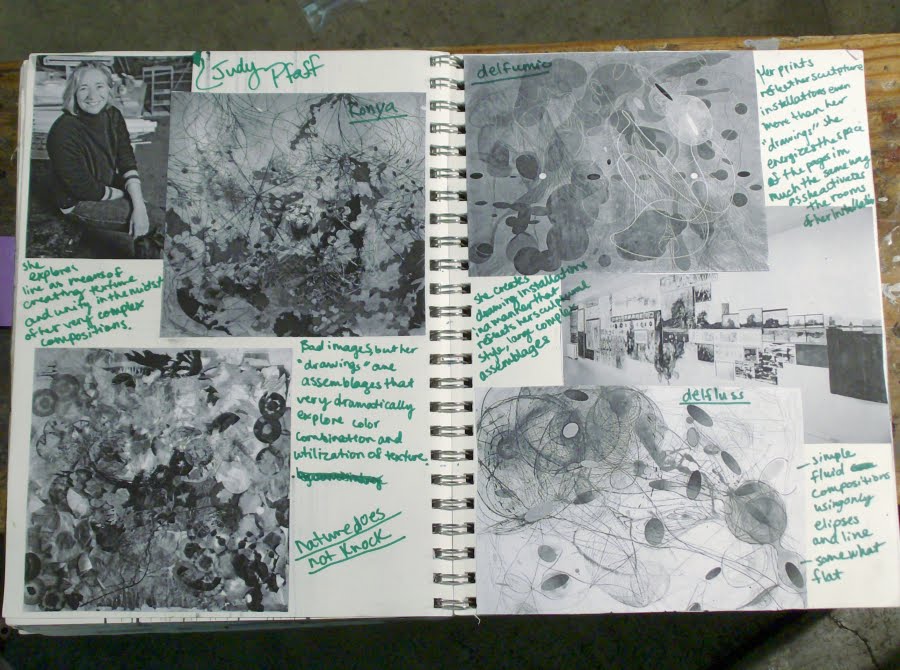
Sketchbook Examples

Here are some good examples from the sketchbooks of past Drawing 1 students. Notice how I have all of them opened to 2-page spreads. This is so you can see how each student decided to design their layouts from page to page.


Just For The Hell Of It: The Kentucky Headhunters!

If you just want a good chuckle, here's a 1993 video from The Kentucky Headhunters. I'm sure you'll see, almost immediately, that these guys were just having fun. They certainly weren't taking things too seriously. And WOW, the sheer amount of hair between the five of them is mind-boggling! Have fun...


And here, almost 20 years later, is Fred Young, drummer of the Kentucky Headhunters, showing us that he's still got it...

A Twitter Interview With David Hockney

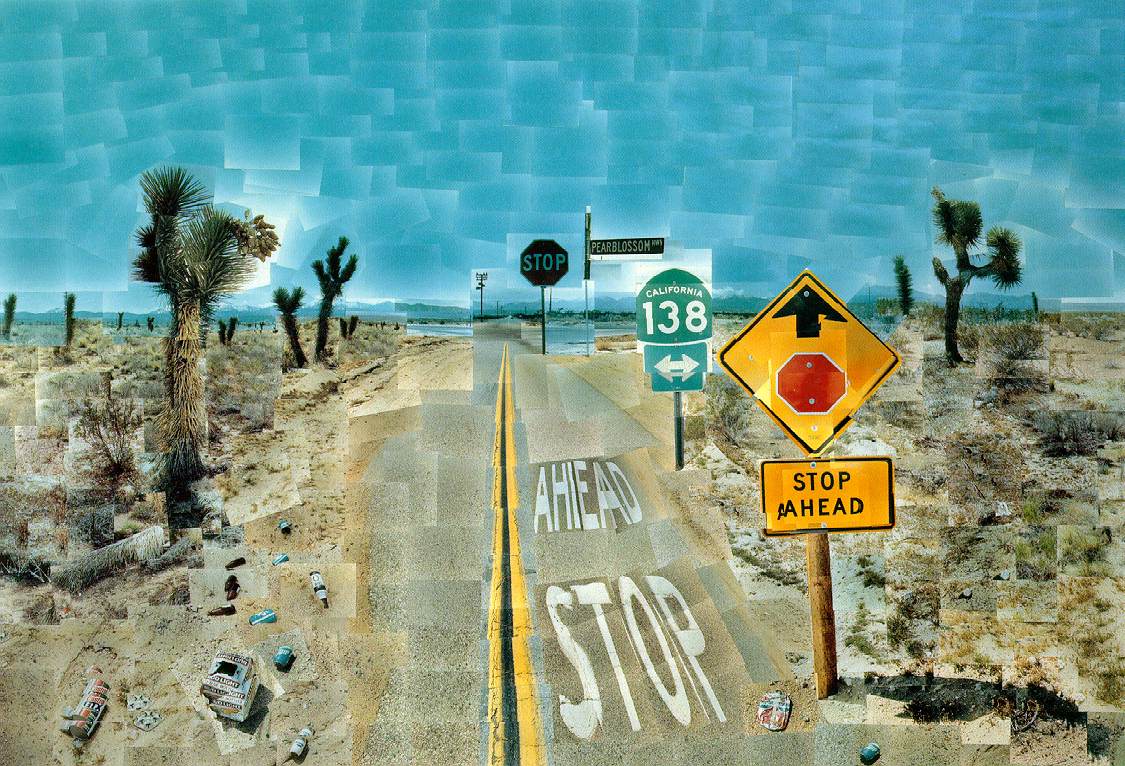
Below is a video interview with David Hockney. Along with the video, I've posted images of the two works of art that are mentioned in the video. Both are very influential and historically important pieces.


Studio Visit With Zak Smith


Ingres, Hockney, and Smith

Here are a few examples from each of the three artists I asked you guys to look at. Don't depend purely on what I'm providing you here, though. Go out and find images from these guys on your own and study what they're doing with their use of line variation.

Jean-Auguste Dominique Ingres
What do you notice about the way Ingres uses line in these portraits to place emphasis in the areas where he wants us to look or to define the form of the figure as existing in three-dimensional space? Is he using a different quality of line on the faces than on clothing? Look at his handling of arms. Notice how with the simple use of a darker, heavier line on one side of the arm and a thin, crisp line on the other side gives the illusion of form and weight. Study these drawings yourself and see what else you discover.


David Hockney
In these drawings, and others like them, Hockney is using a single fine-point pen. One would think that it would be difficult to manage any line variation from such a precision tool, but he dose it. Hockney had a great amount of control and patience, therefore when he needed a darker or heavier line he would repeatedly trace and retrace the line until he was satisfied with it. He doesn't do it with every single line on the picture plane, or else the drawing would be visually flat. Scan the drawings for line variations and see if you can figure out what effect each different kind of line is achieving.


Zak Smith
Smith is an extreme case. It is stating the obvious to point out that all of these drawings make IMMENSE use of line variation. Your job is to study them and observe the ways that line variation creates a push-and-pull of space. Also, how is Smith using line variation and positive/negative space relationships to maintain visual interest?